'/%3e%3cpath%20id='spade'%20class='cls-2'%20d='M196.08,56.6l13.014,57.987-0.309-9.652,5.264-1.239c1.872,8.514,1.127,16.417-3.508,21.2-6.22-2.229-10.283-9-12.255-17.49l6.371-1.5L193.731,57.155a7.077,7.077,0,0,1-7.267-5.564,7.263,7.263,0,0,1,.171-3.822l11.8-2.777A7.261,7.261,0,0,1,196.08,56.6Zm1.688-8.932-9.39,2.209a4.523,4.523,0,0,0,.1,1.237,4.82,4.82,0,0,0,5.909,3.472,4.922,4.922,0,0,0,3.822-5.762A4.461,4.461,0,0,0,197.768,47.67Z'%20transform='translate(-94.969%20-45)'/%3e%3cpath%20id='GARDEN'%20class='cls-2'%20d='M118.015,68.918H119.6V73c0,1.581-.7,2.15-1.81,2.15s-1.809-.569-1.809-2.15V61.045c0-1.581.7-2.182,1.809-2.182s1.81,0.6,1.81,2.182v2.371h3.3v-2.15c0-3.541-1.778-5.565-5.206-5.565s-5.206,2.024-5.206,5.565V72.775c0,3.541,1.778,5.565,5.206,5.565s5.206-2.024,5.206-5.565V65.756h-4.889v3.162Zm16.127-12.963h-5.111l-3.556,22.133h3.206l0.6-4.016h4.285l0.6,4.016H137.7Zm-2.731,3.92,1.683,11.193h-3.365Zm20.031,18.212a6.5,6.5,0,0,1-.381-2.688V71.985c0-2.308-.572-3.984-2.317-4.711,1.555-.727,2.285-2.213,2.285-4.49V61.045c0-3.415-1.555-5.09-5.174-5.09h-5.27V78.087h3.492V69.076h1.206c1.588,0,2.286.759,2.286,2.814v3.478a6.8,6.8,0,0,0,.317,2.719h3.556ZM145.76,59.116c1.238,0,1.777.7,1.777,2.276v2.182c0,1.771-.793,2.34-2.095,2.34h-1.365v-6.8h1.683Zm8.855,18.971h5.524c3.492,0,5.206-1.929,5.206-5.47V61.424c0-3.541-1.714-5.47-5.206-5.47h-5.524V78.087Zm5.461-18.971c1.111,0,1.777.569,1.777,2.15V72.775c0,1.581-.666,2.15-1.777,2.15h-1.969V59.116h1.969Zm12.252,0h6.032V55.954h-9.524V78.087h9.524V74.925h-6.032V68.444h4.794V65.282h-4.794V59.116Zm16.92,18.971h3.587V55.954h-3.111V69.2l-3.588-13.248h-4.38V78.087H184.9V62.057Z'%20transform='translate(-94.969%20-45)'/%3e%3cpath%20id='SCAPE'%20class='cls-3'%20d='M110.82,88.258c0,8.278,8.935,9.4,8.935,15.357,0,2.069-.915,2.814-2.369,2.814s-2.369-.745-2.369-2.814v-2.07H110.7v1.78c0,4.636,2.327,7.285,6.816,7.285s6.815-2.649,6.815-7.285c0-8.278-8.935-9.4-8.935-15.356,0-2.07.831-2.856,2.286-2.856s2.286,0.786,2.286,2.856v1.2h4.322V88.258c0-4.636-2.286-7.285-6.733-7.285S110.82,83.622,110.82,88.258Zm26.72,11.217v4.14c0,2.069-.914,2.814-2.369,2.814s-2.369-.745-2.369-2.814V87.969c0-2.07.915-2.856,2.369-2.856s2.369,0.786,2.369,2.856v3.1h4.322V88.258c0-4.636-2.327-7.285-6.815-7.285s-6.816,2.649-6.816,7.285v15.067c0,4.636,2.327,7.285,6.816,7.285s6.815-2.649,6.815-7.285v-3.85H137.54ZM156.447,81.3h-6.691L145.1,110.279h4.2l0.79-5.257h5.61l0.79,5.257H161.1Zm-3.574,5.133,2.2,14.653h-4.405ZM171.614,81.3h-6.732v28.975h4.571V99.393h2.161c4.572,0,6.816-2.525,6.816-7.161V88.465C178.43,83.829,176.186,81.3,171.614,81.3Zm0,4.139c1.455,0,2.245.662,2.245,2.732v4.346c0,2.07-.79,2.732-2.245,2.732h-2.161v-9.81h2.161Zm15.168,0h7.9V81.3H182.211v28.975h12.467V106.14h-7.9V97.654h6.275V93.515h-6.275V85.443Z'%20transform='translate(-94.969%20-45)'/%3e%3c/svg%3e)
Patio layers for new patios and extensions
Looking for patio layers near you? Gardenscape designs and builds patios across Essex, working from Southend-on-Sea. We install natural stone, porcelain and block paving, with groundwork and drainage considered before the finished surface. A patio should provide useful outdoor space and connect properly to the house, lawn and paths.
A free site visit lets us discuss the layout and measure the area. You receive one fixed written quote for the agreed preparation and installation. Whether you want a new seating area or a patio extension, explain how you want to use it before settling on the slab or block.
Choosing porcelain, stone or block paving
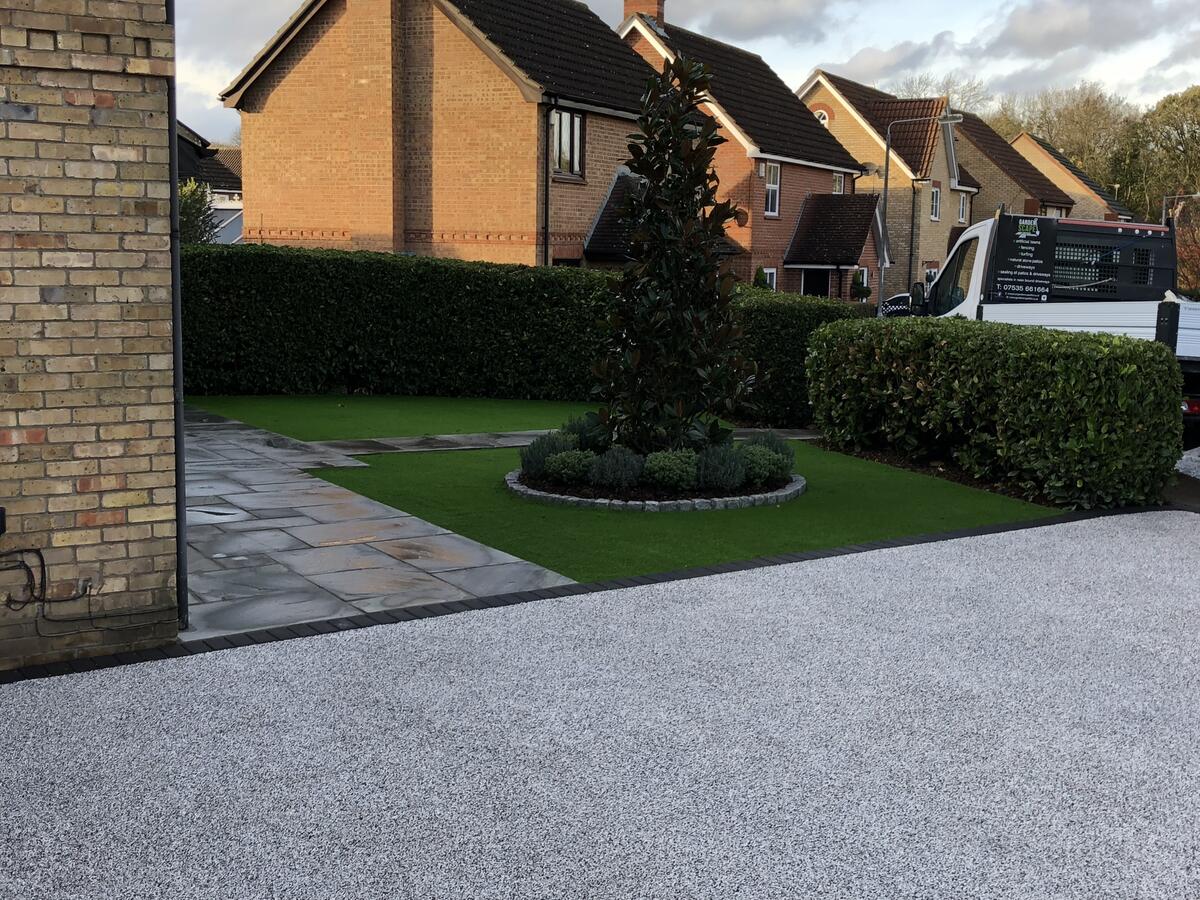
Porcelain and natural stone offer different appearances and care requirements. Compare the surface finish as well as the shape and colour variation. Large slabs can give a different rhythm from smaller units, but the best choice still depends on the garden layout and how the surface will be used. Our patio materials guide helps you weigh up those decisions.
A block paving patio uses smaller units and can relate to adjoining paths or a driveway. It is also a different construction from a slab patio, so the base, edge restraint and joints need to suit the material. Choosing a surface is not a reason to overlook what supports it. We explain the proposed construction in the discussion before quoting.
A layout that works with furniture and access
Mark out the space needed for a table, chairs and a clear route past them. A patio that fits furniture tightly can be awkward once people are seated. Think about the doors you use, the route to bins and the part of the garden you want to keep open. A useful layout allows movement rather than filling every available corner with paving.
A circle patio or curved edge can make a separate seating space, while a simple rectangle may sit better against the house. Neither shape is automatically better. Curves, cuts and borders need considering alongside the material dimensions so the finished edge looks intentional. Planting around the paving can soften the transition without narrowing the walking route.
Patio extensions and steps
Extending an existing patio starts with checking the old surface. Its level, condition and drainage may limit how a new section connects. A close visual match does not necessarily mean the construction beneath is suitable, and weathered slabs can look different from new ones even when the product name is the same.
For a patio with steps, consider where the change in level belongs and how people move through it. An edge beside a lawn is different from the approach to a door. Raised areas and retaining features need planning together with the paved surface. Do not use an extra layer of paving simply to disguise movement or a drainage problem underneath.
Groundwork and water
A patio needs support appropriate to the surface and ground. The work may involve removing old paving, excavating and preparing the foundation before the finish is laid. Water must have an appropriate route away, and the proposed level needs checking against door thresholds and the building. Those decisions should come before a favourite slab is ordered.
In a shaded garden, leaves and surface growth also affect use and upkeep. Our problem guides explain slippery paving and moving slabs. They are useful when deciding whether you need a new patio or attention to the existing one. If a repair or relaying is worth discussing, that can be considered at the visit rather than assuming replacement is always necessary.
How much does a new patio cost?
New patio cost depends on the area, material, ground preparation, access and details such as steps or curved edges. The price of a slab alone is not an installed price. Removal, foundation work and finishing need to be part of the same comparison, otherwise two quotations may describe very different jobs.
We do not give a made-up average cost for your garden. Gardenscape measures and checks the site before issuing one fixed written quote. Bring photographs or material ideas if you have them, but keep the intended use at the centre of the conversation. An appropriate patio is one that fits the garden, drainage and daily routine as well as its appearance.
Your questions answered
Can you extend an existing patio?
An extension can be discussed after the condition, level and drainage of the existing paving are checked. The connection and material match need agreeing before new work is specified.
Which patio material is best?
Porcelain, natural stone and block paving suit different layouts and preferences. Consider the finish, maintenance and construction together rather than selecting on appearance alone.
Can a new patio include steps?
Steps can form part of a landscaped layout. Their position should be planned with the levels, access routes and any retaining work, not added after the surface is finished.
How much does patio installation cost?
Area, materials, preparation, access and finishing details affect the cost. A free site visit provides the information for one fixed written quote for your garden.