'/%3e%3cpath%20id='spade'%20class='cls-2'%20d='M196.08,56.6l13.014,57.987-0.309-9.652,5.264-1.239c1.872,8.514,1.127,16.417-3.508,21.2-6.22-2.229-10.283-9-12.255-17.49l6.371-1.5L193.731,57.155a7.077,7.077,0,0,1-7.267-5.564,7.263,7.263,0,0,1,.171-3.822l11.8-2.777A7.261,7.261,0,0,1,196.08,56.6Zm1.688-8.932-9.39,2.209a4.523,4.523,0,0,0,.1,1.237,4.82,4.82,0,0,0,5.909,3.472,4.922,4.922,0,0,0,3.822-5.762A4.461,4.461,0,0,0,197.768,47.67Z'%20transform='translate(-94.969%20-45)'/%3e%3cpath%20id='GARDEN'%20class='cls-2'%20d='M118.015,68.918H119.6V73c0,1.581-.7,2.15-1.81,2.15s-1.809-.569-1.809-2.15V61.045c0-1.581.7-2.182,1.809-2.182s1.81,0.6,1.81,2.182v2.371h3.3v-2.15c0-3.541-1.778-5.565-5.206-5.565s-5.206,2.024-5.206,5.565V72.775c0,3.541,1.778,5.565,5.206,5.565s5.206-2.024,5.206-5.565V65.756h-4.889v3.162Zm16.127-12.963h-5.111l-3.556,22.133h3.206l0.6-4.016h4.285l0.6,4.016H137.7Zm-2.731,3.92,1.683,11.193h-3.365Zm20.031,18.212a6.5,6.5,0,0,1-.381-2.688V71.985c0-2.308-.572-3.984-2.317-4.711,1.555-.727,2.285-2.213,2.285-4.49V61.045c0-3.415-1.555-5.09-5.174-5.09h-5.27V78.087h3.492V69.076h1.206c1.588,0,2.286.759,2.286,2.814v3.478a6.8,6.8,0,0,0,.317,2.719h3.556ZM145.76,59.116c1.238,0,1.777.7,1.777,2.276v2.182c0,1.771-.793,2.34-2.095,2.34h-1.365v-6.8h1.683Zm8.855,18.971h5.524c3.492,0,5.206-1.929,5.206-5.47V61.424c0-3.541-1.714-5.47-5.206-5.47h-5.524V78.087Zm5.461-18.971c1.111,0,1.777.569,1.777,2.15V72.775c0,1.581-.666,2.15-1.777,2.15h-1.969V59.116h1.969Zm12.252,0h6.032V55.954h-9.524V78.087h9.524V74.925h-6.032V68.444h4.794V65.282h-4.794V59.116Zm16.92,18.971h3.587V55.954h-3.111V69.2l-3.588-13.248h-4.38V78.087H184.9V62.057Z'%20transform='translate(-94.969%20-45)'/%3e%3cpath%20id='SCAPE'%20class='cls-3'%20d='M110.82,88.258c0,8.278,8.935,9.4,8.935,15.357,0,2.069-.915,2.814-2.369,2.814s-2.369-.745-2.369-2.814v-2.07H110.7v1.78c0,4.636,2.327,7.285,6.816,7.285s6.815-2.649,6.815-7.285c0-8.278-8.935-9.4-8.935-15.356,0-2.07.831-2.856,2.286-2.856s2.286,0.786,2.286,2.856v1.2h4.322V88.258c0-4.636-2.286-7.285-6.733-7.285S110.82,83.622,110.82,88.258Zm26.72,11.217v4.14c0,2.069-.914,2.814-2.369,2.814s-2.369-.745-2.369-2.814V87.969c0-2.07.915-2.856,2.369-2.856s2.369,0.786,2.369,2.856v3.1h4.322V88.258c0-4.636-2.327-7.285-6.815-7.285s-6.816,2.649-6.816,7.285v15.067c0,4.636,2.327,7.285,6.816,7.285s6.815-2.649,6.815-7.285v-3.85H137.54ZM156.447,81.3h-6.691L145.1,110.279h4.2l0.79-5.257h5.61l0.79,5.257H161.1Zm-3.574,5.133,2.2,14.653h-4.405ZM171.614,81.3h-6.732v28.975h4.571V99.393h2.161c4.572,0,6.816-2.525,6.816-7.161V88.465C178.43,83.829,176.186,81.3,171.614,81.3Zm0,4.139c1.455,0,2.245.662,2.245,2.732v4.346c0,2.07-.79,2.732-2.245,2.732h-2.161v-9.81h2.161Zm15.168,0h7.9V81.3H182.211v28.975h12.467V106.14h-7.9V97.654h6.275V93.515h-6.275V85.443Z'%20transform='translate(-94.969%20-45)'/%3e%3c/svg%3e)
Individual patio slabs moving underfoot
Relaying Loose Patio Slabs: Fix It Properly
To relay a loose patio slab, lift it, clear out the old bedding, lay a fresh full bed of mortar, tap the slab down level with its neighbours and re-point the joints. If several slabs keep coming loose, the bedding or sub-base under the whole patio has failed and patching one slab at a time will not last.
A slab that rocks has lost contact with its bed. Nine times out of ten the cause is spot bedding — five dabs of mortar under each slab, leaving voids that fill with water and eventually collapse.
The slab is rarely at fault, which is why relaying usually reuses the original paving.
Need this sorted?
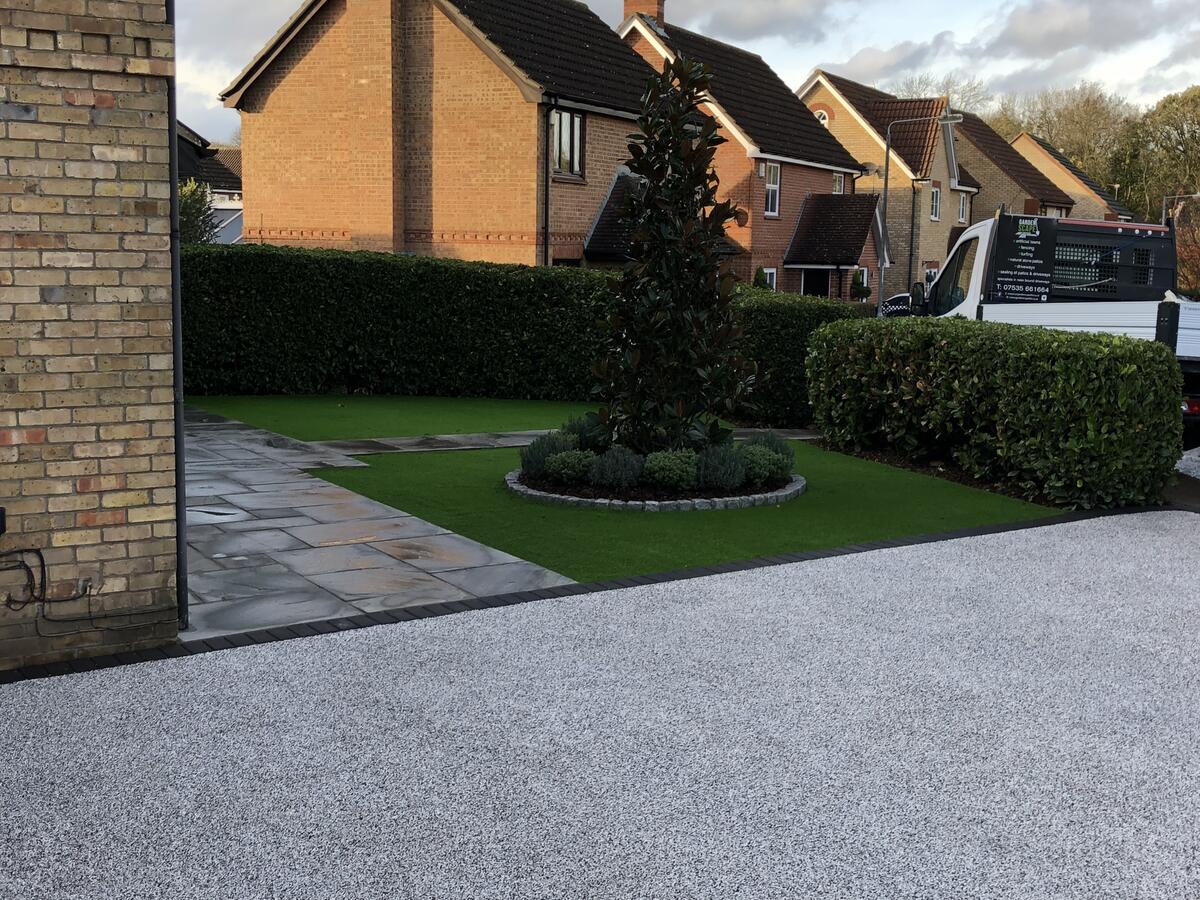
Need patio and landscaping? Get a quote from Gardenscape.
Why spot bedding fails
Voids under a slab hold water. In winter that water freezes and expands, breaking the bond and cracking the slab from below. Foot traffic and furniture then finish the job.
Full-bed laying on a wet mortar bed with a primer slurry on the slab back removes the voids entirely.
Localised repair versus full relay
One or two loose slabs on an otherwise sound patio are a straightforward lift, clean, re-bed and repoint.
Where many slabs are hollow, or the whole patio was spot bedded, piecemeal repairs simply move the problem along. A full lift and relay onto a compacted base with correct falls is the cost-effective route.
Patio and Landscaping
- Natural stone and porcelain paving
- Groundwork and drainage handled
- Planting and turfing for landscaped gardens
Falls, pointing and the damp course
A patio should fall away from the house at roughly one in eighty and finish at least 150mm below the damp proof course where it abuts the building.
Repointing with a purpose-made jointing mortar rather than a brushed-in dry mix keeps water out of the bed in the first place.
Want a professional to handle it?
Related services
Covering Essex
Frequently asked questions
Can I relay a loose patio slab myself?
One slab, yes: lift it, clean the base, bed it on fresh mortar and re-point. If slabs keep lifting across the patio, the sub-base is the problem and needs looking at properly.
Can loose slabs be re-bedded individually?
Yes, provided the surrounding paving is stable and the base beneath is sound.
Why do slabs crack in winter?
Trapped water in voids under spot-bedded slabs freezes and forces the slab apart from underneath.
Can you reuse my existing slabs?
Usually. Natural stone and porcelain both clean up well; only cracked pieces need replacing.
Related reading
Patio slabs moving underfoot?
We repair and fully relay patios across Essex on properly built bases.