'/%3e%3cpath%20id='spade'%20class='cls-2'%20d='M196.08,56.6l13.014,57.987-0.309-9.652,5.264-1.239c1.872,8.514,1.127,16.417-3.508,21.2-6.22-2.229-10.283-9-12.255-17.49l6.371-1.5L193.731,57.155a7.077,7.077,0,0,1-7.267-5.564,7.263,7.263,0,0,1,.171-3.822l11.8-2.777A7.261,7.261,0,0,1,196.08,56.6Zm1.688-8.932-9.39,2.209a4.523,4.523,0,0,0,.1,1.237,4.82,4.82,0,0,0,5.909,3.472,4.922,4.922,0,0,0,3.822-5.762A4.461,4.461,0,0,0,197.768,47.67Z'%20transform='translate(-94.969%20-45)'/%3e%3cpath%20id='GARDEN'%20class='cls-2'%20d='M118.015,68.918H119.6V73c0,1.581-.7,2.15-1.81,2.15s-1.809-.569-1.809-2.15V61.045c0-1.581.7-2.182,1.809-2.182s1.81,0.6,1.81,2.182v2.371h3.3v-2.15c0-3.541-1.778-5.565-5.206-5.565s-5.206,2.024-5.206,5.565V72.775c0,3.541,1.778,5.565,5.206,5.565s5.206-2.024,5.206-5.565V65.756h-4.889v3.162Zm16.127-12.963h-5.111l-3.556,22.133h3.206l0.6-4.016h4.285l0.6,4.016H137.7Zm-2.731,3.92,1.683,11.193h-3.365Zm20.031,18.212a6.5,6.5,0,0,1-.381-2.688V71.985c0-2.308-.572-3.984-2.317-4.711,1.555-.727,2.285-2.213,2.285-4.49V61.045c0-3.415-1.555-5.09-5.174-5.09h-5.27V78.087h3.492V69.076h1.206c1.588,0,2.286.759,2.286,2.814v3.478a6.8,6.8,0,0,0,.317,2.719h3.556ZM145.76,59.116c1.238,0,1.777.7,1.777,2.276v2.182c0,1.771-.793,2.34-2.095,2.34h-1.365v-6.8h1.683Zm8.855,18.971h5.524c3.492,0,5.206-1.929,5.206-5.47V61.424c0-3.541-1.714-5.47-5.206-5.47h-5.524V78.087Zm5.461-18.971c1.111,0,1.777.569,1.777,2.15V72.775c0,1.581-.666,2.15-1.777,2.15h-1.969V59.116h1.969Zm12.252,0h6.032V55.954h-9.524V78.087h9.524V74.925h-6.032V68.444h4.794V65.282h-4.794V59.116Zm16.92,18.971h3.587V55.954h-3.111V69.2l-3.588-13.248h-4.38V78.087H184.9V62.057Z'%20transform='translate(-94.969%20-45)'/%3e%3cpath%20id='SCAPE'%20class='cls-3'%20d='M110.82,88.258c0,8.278,8.935,9.4,8.935,15.357,0,2.069-.915,2.814-2.369,2.814s-2.369-.745-2.369-2.814v-2.07H110.7v1.78c0,4.636,2.327,7.285,6.816,7.285s6.815-2.649,6.815-7.285c0-8.278-8.935-9.4-8.935-15.356,0-2.07.831-2.856,2.286-2.856s2.286,0.786,2.286,2.856v1.2h4.322V88.258c0-4.636-2.286-7.285-6.733-7.285S110.82,83.622,110.82,88.258Zm26.72,11.217v4.14c0,2.069-.914,2.814-2.369,2.814s-2.369-.745-2.369-2.814V87.969c0-2.07.915-2.856,2.369-2.856s2.369,0.786,2.369,2.856v3.1h4.322V88.258c0-4.636-2.327-7.285-6.815-7.285s-6.816,2.649-6.816,7.285v15.067c0,4.636,2.327,7.285,6.816,7.285s6.815-2.649,6.815-7.285v-3.85H137.54ZM156.447,81.3h-6.691L145.1,110.279h4.2l0.79-5.257h5.61l0.79,5.257H161.1Zm-3.574,5.133,2.2,14.653h-4.405ZM171.614,81.3h-6.732v28.975h4.571V99.393h2.161c4.572,0,6.816-2.525,6.816-7.161V88.465C178.43,83.829,176.186,81.3,171.614,81.3Zm0,4.139c1.455,0,2.245.662,2.245,2.732v4.346c0,2.07-.79,2.732-2.245,2.732h-2.161v-9.81h2.161Zm15.168,0h7.9V81.3H182.211v28.975h12.467V106.14h-7.9V97.654h6.275V93.515h-6.275V85.443Z'%20transform='translate(-94.969%20-45)'/%3e%3c/svg%3e)
Limestone paving for patios
Gardenscape lays limestone paving for patios across its Essex service area. Limestone is a natural stone with a smoother, more even surface than sandstone, chosen where a consistent colour and a calm, contemporary look are wanted. The stone is only part of the job: the base, levels and drainage decide how the patio performs.
We discuss the space on a free site visit and provide one fixed written quote for the agreed work. This page covers limestone specifically; our sandstone versus limestone comparison weighs the two stones side by side, and the patios page covers the wider material choices.
What limestone offers a patio
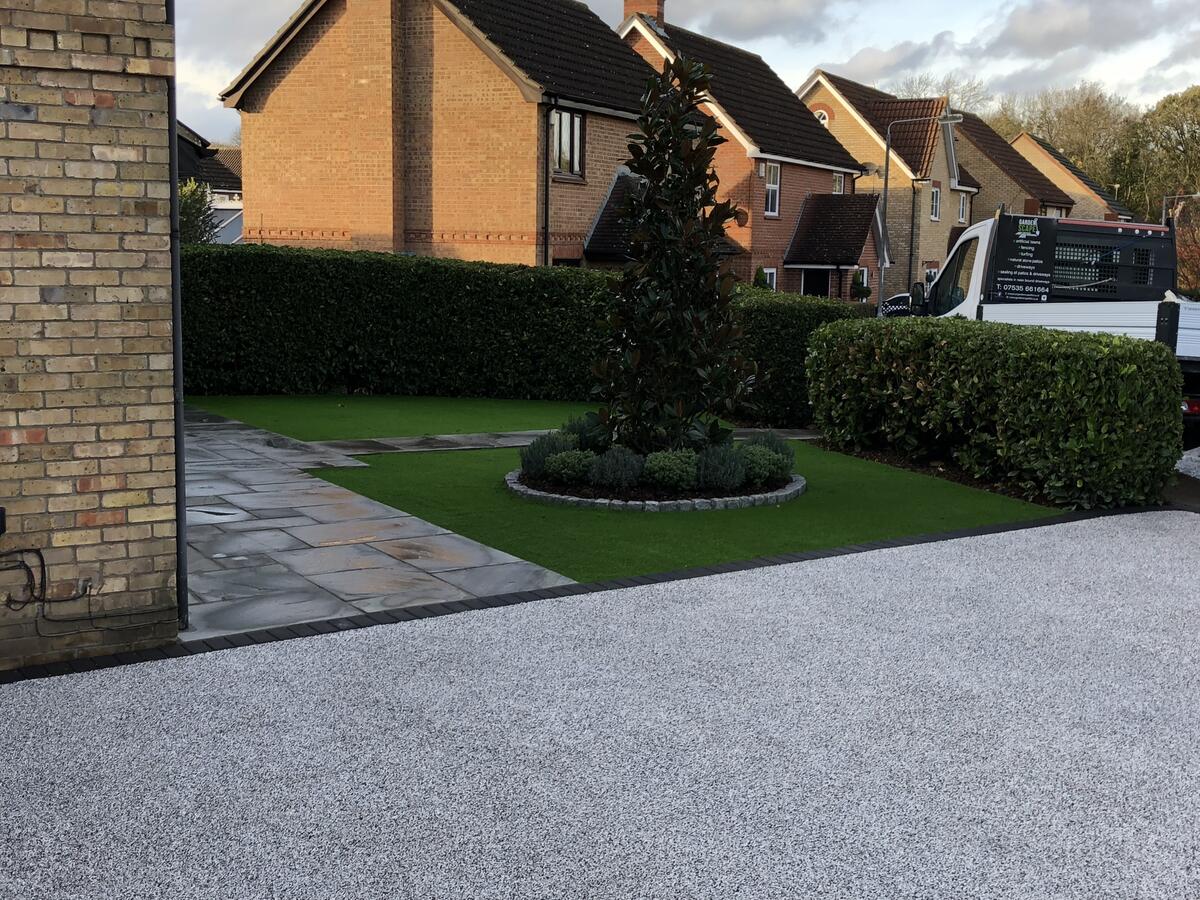
Limestone has a fine, even grain and a naturally flat surface, which gives a patio a uniform look. The colour range runs from light buffs to deep greys and near-black tones. Compared with sandstone, the variation within a pack is usually smaller, so the finished area reads as one consistent surface.
The stone is softer than granite, which makes it easier to cut and shape for curves, edges and steps. That workability suits gardens where the patio needs to meet planting, a path or a change of level neatly. The trade-off is that the surface needs a little more care to keep its appearance.
Colour, fading and sealing
Limestone can lighten over time in strong sun, and darker stones show this more than pale ones. A suitable sealant, applied as the product guidance directs, can help hold the colour and resist staining. Sealing is a choice to discuss, not an automatic extra; the right answer depends on the stone and how you use the space.
Ask to see samples in the garden light before deciding, and remember the colour deepens when wet. If the patio sits beside planting or a lawn, think about how soil and leaves reach the surface. Pale stone shows organic marks sooner; a textured finish hides everyday use better than a smooth one.
Base, laying and drainage
Limestone slabs need a full mortar bed on a sound sub-base, laid to falls that move water off the surface in a controlled direction. Because the stone is softer, the edges and corners deserve care during laying; a chipped edge is harder to disguise on an even surface than on a riven one.
On a clay or wet plot, the sub-base and drainage deserve as much attention as the stone itself. Tell us about any standing water or soft ground at the visit so the construction can be specified for the actual site. A new surface over a failing base inherits its problems, whatever stone sits on top.
Care and the fitted quote
Limestone needs regular sweeping and a wash-down with a suitable cleaner. Avoid acidic products, which can mark the stone, and do not assume a close pressure-washer jet is safe on every finish. Clear leaves before they sit and stain, particularly on the paler colours.
A fitted price depends on the stone, the area, the pattern, cutting, access and preparation. There is no invented limestone rate on this page. Gardenscape measures the space on a free visit and sets out one fixed written quote for the agreed work, so you can compare the complete specification rather than a stone-only figure.
Your questions answered
Does limestone paving fade?
It can lighten in strong sun, especially the darker stones. A suitable sealant, applied as the product guidance directs, can help hold the colour. The options are discussed during the survey.
Is limestone better than sandstone for a patio?
Neither is simply better. Limestone gives a more even colour and flatter surface; sandstone offers more natural variation. Our comparison page weighs the two, and the survey matches the stone to your garden.
Can I use a pressure washer on limestone?
With care. A close jet can damage the surface and joints. Use a suitable cleaner and follow the care guidance for the chosen product.
How much does a limestone patio cost?
The price depends on the stone, area, pattern, cutting, access and preparation. A free site visit provides the measurements for one fixed written quote.