'/%3e%3cpath%20id='spade'%20class='cls-2'%20d='M196.08,56.6l13.014,57.987-0.309-9.652,5.264-1.239c1.872,8.514,1.127,16.417-3.508,21.2-6.22-2.229-10.283-9-12.255-17.49l6.371-1.5L193.731,57.155a7.077,7.077,0,0,1-7.267-5.564,7.263,7.263,0,0,1,.171-3.822l11.8-2.777A7.261,7.261,0,0,1,196.08,56.6Zm1.688-8.932-9.39,2.209a4.523,4.523,0,0,0,.1,1.237,4.82,4.82,0,0,0,5.909,3.472,4.922,4.922,0,0,0,3.822-5.762A4.461,4.461,0,0,0,197.768,47.67Z'%20transform='translate(-94.969%20-45)'/%3e%3cpath%20id='GARDEN'%20class='cls-2'%20d='M118.015,68.918H119.6V73c0,1.581-.7,2.15-1.81,2.15s-1.809-.569-1.809-2.15V61.045c0-1.581.7-2.182,1.809-2.182s1.81,0.6,1.81,2.182v2.371h3.3v-2.15c0-3.541-1.778-5.565-5.206-5.565s-5.206,2.024-5.206,5.565V72.775c0,3.541,1.778,5.565,5.206,5.565s5.206-2.024,5.206-5.565V65.756h-4.889v3.162Zm16.127-12.963h-5.111l-3.556,22.133h3.206l0.6-4.016h4.285l0.6,4.016H137.7Zm-2.731,3.92,1.683,11.193h-3.365Zm20.031,18.212a6.5,6.5,0,0,1-.381-2.688V71.985c0-2.308-.572-3.984-2.317-4.711,1.555-.727,2.285-2.213,2.285-4.49V61.045c0-3.415-1.555-5.09-5.174-5.09h-5.27V78.087h3.492V69.076h1.206c1.588,0,2.286.759,2.286,2.814v3.478a6.8,6.8,0,0,0,.317,2.719h3.556ZM145.76,59.116c1.238,0,1.777.7,1.777,2.276v2.182c0,1.771-.793,2.34-2.095,2.34h-1.365v-6.8h1.683Zm8.855,18.971h5.524c3.492,0,5.206-1.929,5.206-5.47V61.424c0-3.541-1.714-5.47-5.206-5.47h-5.524V78.087Zm5.461-18.971c1.111,0,1.777.569,1.777,2.15V72.775c0,1.581-.666,2.15-1.777,2.15h-1.969V59.116h1.969Zm12.252,0h6.032V55.954h-9.524V78.087h9.524V74.925h-6.032V68.444h4.794V65.282h-4.794V59.116Zm16.92,18.971h3.587V55.954h-3.111V69.2l-3.588-13.248h-4.38V78.087H184.9V62.057Z'%20transform='translate(-94.969%20-45)'/%3e%3cpath%20id='SCAPE'%20class='cls-3'%20d='M110.82,88.258c0,8.278,8.935,9.4,8.935,15.357,0,2.069-.915,2.814-2.369,2.814s-2.369-.745-2.369-2.814v-2.07H110.7v1.78c0,4.636,2.327,7.285,6.816,7.285s6.815-2.649,6.815-7.285c0-8.278-8.935-9.4-8.935-15.356,0-2.07.831-2.856,2.286-2.856s2.286,0.786,2.286,2.856v1.2h4.322V88.258c0-4.636-2.286-7.285-6.733-7.285S110.82,83.622,110.82,88.258Zm26.72,11.217v4.14c0,2.069-.914,2.814-2.369,2.814s-2.369-.745-2.369-2.814V87.969c0-2.07.915-2.856,2.369-2.856s2.369,0.786,2.369,2.856v3.1h4.322V88.258c0-4.636-2.327-7.285-6.815-7.285s-6.816,2.649-6.816,7.285v15.067c0,4.636,2.327,7.285,6.816,7.285s6.815-2.649,6.815-7.285v-3.85H137.54ZM156.447,81.3h-6.691L145.1,110.279h4.2l0.79-5.257h5.61l0.79,5.257H161.1Zm-3.574,5.133,2.2,14.653h-4.405ZM171.614,81.3h-6.732v28.975h4.571V99.393h2.161c4.572,0,6.816-2.525,6.816-7.161V88.465C178.43,83.829,176.186,81.3,171.614,81.3Zm0,4.139c1.455,0,2.245.662,2.245,2.732v4.346c0,2.07-.79,2.732-2.245,2.732h-2.161v-9.81h2.161Zm15.168,0h7.9V81.3H182.211v28.975h12.467V106.14h-7.9V97.654h6.275V93.515h-6.275V85.443Z'%20transform='translate(-94.969%20-45)'/%3e%3c/svg%3e)
Granite paving for patios and paths
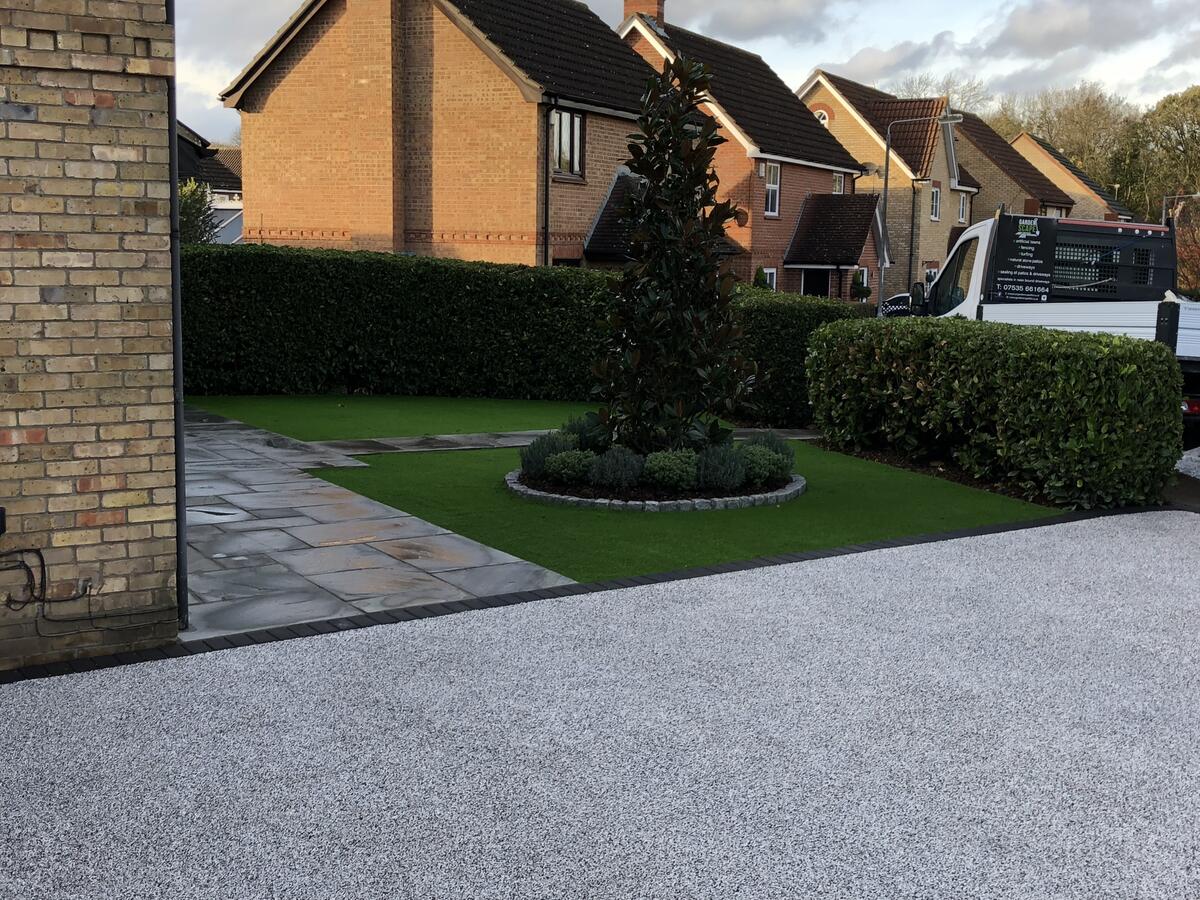
Gardenscape lays granite paving for patios and paths across its Essex service area. Granite is a hard natural stone with a tight grain, chosen where a durable, smart surface is wanted. As with any paving, the stone is only part of the job: the base, levels and drainage decide how the patio performs.
We discuss the space on a free site visit and provide one fixed written quote for the agreed work. Tell us how you want to use the area, what is there now and whether any features must stay. This page covers granite specifically; the patios page compares the wider material choices.
What granite offers a patio
Granite is one of the hardest paving stones in common use. It resists scratching and wear, copes well with furniture and foot traffic, and keeps its appearance with simple cleaning. The tight grain means it absorbs little water, which helps it resist staining and frost damage compared with more porous stones.
The finish changes the character. Flamed or textured surfaces give more grip underfoot, while a sawn or polished face looks sleeker but can be slippery when wet. For an outdoor patio in the British climate, a textured finish is the practical starting point; the exact product is agreed during the survey.
Where granite suits the garden
A granite patio suits a seating area that gets heavy use, a path that must stay smart, or a modern layout where clean lines matter. The stone comes in a range of greys and darker tones, and the colour you see dry will deepen when wet. Ask to see samples in the garden light before deciding.
Granite also pairs well with other materials. A granite path can meet a block paved drive or a planted border without clashing. If the project includes steps, edges or a change of level, those details are planned with the paving so the finished surface reads as one piece of work.
Base, laying and cutting
Granite is dense and heavy, which makes cutting slower and handling harder than with softer stone. That affects the labour in the job, and it is one reason a fitted granite quote differs from a pack price. The slabs still need a proper mortar bed on a sound sub-base; the strength of the stone does not excuse weak preparation.
Levels and falls are set so water leaves the surface in a controlled direction. On a clay or wet plot, the sub-base and drainage deserve as much attention as the stone itself. Tell us about any standing water or soft ground at the visit so the construction can be specified for the actual site.
Care and the fitted quote
Granite needs little day-to-day care: sweep it, wash it down and clear leaves before they sit and mark. Avoid assuming strong chemicals suit every stone; follow the care guidance for the chosen product. Joints and edges should be checked occasionally, as with any paving.
A fitted price depends on the stone, the area, the pattern, cutting, access and preparation. There is no invented granite rate on this page. Gardenscape measures the space on a free visit and sets out one fixed written quote for the agreed work, so you can compare the complete specification rather than a stone-only figure.
Your questions answered
Is granite slippery when wet?
A polished face can be. Textured finishes such as flamed granite give more grip and are the practical choice for an outdoor patio. The finish is agreed during the survey.
Does granite paving need sealing?
Granite absorbs little water compared with porous stones, so sealing is less critical. Follow the care guidance for the chosen product rather than applying treatments by default.
Can granite be laid over my existing patio?
Only if the existing base is sound and suitable. The survey checks what is there before the construction is specified; a new surface over a failing base inherits its problems.
How much does a granite patio cost?
The price depends on the stone, area, pattern, cutting, access and preparation. A free site visit provides the measurements for one fixed written quote.