'/%3e%3cpath%20id='spade'%20class='cls-2'%20d='M196.08,56.6l13.014,57.987-0.309-9.652,5.264-1.239c1.872,8.514,1.127,16.417-3.508,21.2-6.22-2.229-10.283-9-12.255-17.49l6.371-1.5L193.731,57.155a7.077,7.077,0,0,1-7.267-5.564,7.263,7.263,0,0,1,.171-3.822l11.8-2.777A7.261,7.261,0,0,1,196.08,56.6Zm1.688-8.932-9.39,2.209a4.523,4.523,0,0,0,.1,1.237,4.82,4.82,0,0,0,5.909,3.472,4.922,4.922,0,0,0,3.822-5.762A4.461,4.461,0,0,0,197.768,47.67Z'%20transform='translate(-94.969%20-45)'/%3e%3cpath%20id='GARDEN'%20class='cls-2'%20d='M118.015,68.918H119.6V73c0,1.581-.7,2.15-1.81,2.15s-1.809-.569-1.809-2.15V61.045c0-1.581.7-2.182,1.809-2.182s1.81,0.6,1.81,2.182v2.371h3.3v-2.15c0-3.541-1.778-5.565-5.206-5.565s-5.206,2.024-5.206,5.565V72.775c0,3.541,1.778,5.565,5.206,5.565s5.206-2.024,5.206-5.565V65.756h-4.889v3.162Zm16.127-12.963h-5.111l-3.556,22.133h3.206l0.6-4.016h4.285l0.6,4.016H137.7Zm-2.731,3.92,1.683,11.193h-3.365Zm20.031,18.212a6.5,6.5,0,0,1-.381-2.688V71.985c0-2.308-.572-3.984-2.317-4.711,1.555-.727,2.285-2.213,2.285-4.49V61.045c0-3.415-1.555-5.09-5.174-5.09h-5.27V78.087h3.492V69.076h1.206c1.588,0,2.286.759,2.286,2.814v3.478a6.8,6.8,0,0,0,.317,2.719h3.556ZM145.76,59.116c1.238,0,1.777.7,1.777,2.276v2.182c0,1.771-.793,2.34-2.095,2.34h-1.365v-6.8h1.683Zm8.855,18.971h5.524c3.492,0,5.206-1.929,5.206-5.47V61.424c0-3.541-1.714-5.47-5.206-5.47h-5.524V78.087Zm5.461-18.971c1.111,0,1.777.569,1.777,2.15V72.775c0,1.581-.666,2.15-1.777,2.15h-1.969V59.116h1.969Zm12.252,0h6.032V55.954h-9.524V78.087h9.524V74.925h-6.032V68.444h4.794V65.282h-4.794V59.116Zm16.92,18.971h3.587V55.954h-3.111V69.2l-3.588-13.248h-4.38V78.087H184.9V62.057Z'%20transform='translate(-94.969%20-45)'/%3e%3cpath%20id='SCAPE'%20class='cls-3'%20d='M110.82,88.258c0,8.278,8.935,9.4,8.935,15.357,0,2.069-.915,2.814-2.369,2.814s-2.369-.745-2.369-2.814v-2.07H110.7v1.78c0,4.636,2.327,7.285,6.816,7.285s6.815-2.649,6.815-7.285c0-8.278-8.935-9.4-8.935-15.356,0-2.07.831-2.856,2.286-2.856s2.286,0.786,2.286,2.856v1.2h4.322V88.258c0-4.636-2.286-7.285-6.733-7.285S110.82,83.622,110.82,88.258Zm26.72,11.217v4.14c0,2.069-.914,2.814-2.369,2.814s-2.369-.745-2.369-2.814V87.969c0-2.07.915-2.856,2.369-2.856s2.369,0.786,2.369,2.856v3.1h4.322V88.258c0-4.636-2.327-7.285-6.815-7.285s-6.816,2.649-6.816,7.285v15.067c0,4.636,2.327,7.285,6.816,7.285s6.815-2.649,6.815-7.285v-3.85H137.54ZM156.447,81.3h-6.691L145.1,110.279h4.2l0.79-5.257h5.61l0.79,5.257H161.1Zm-3.574,5.133,2.2,14.653h-4.405ZM171.614,81.3h-6.732v28.975h4.571V99.393h2.161c4.572,0,6.816-2.525,6.816-7.161V88.465C178.43,83.829,176.186,81.3,171.614,81.3Zm0,4.139c1.455,0,2.245.662,2.245,2.732v4.346c0,2.07-.79,2.732-2.245,2.732h-2.161v-9.81h2.161Zm15.168,0h7.9V81.3H182.211v28.975h12.467V106.14h-7.9V97.654h6.275V93.515h-6.275V85.443Z'%20transform='translate(-94.969%20-45)'/%3e%3c/svg%3e)
Cracking in an existing concrete driveway
Concrete Driveway Repair: Fill, Overlay or Replace?
Concrete driveway repair depends on the crack: fine surface crazing can be filled or covered with a resin overlay on a sound slab, while cracks that move, widen or step because the base has failed mean the drive needs digging out and replacing.
Concrete cracks for predictable reasons: shrinkage as it cured, thermal movement with no expansion joints, or a base that was never strong enough for the loads above it.
Reading which of those you have is what tells you whether the slab can be kept.
Need this sorted?
Need block paving? Get a quote from Gardenscape.
Cracks that are cosmetic
Fine surface crazing and narrow shrinkage cracks with no height difference either side are rarely structural. If the slab rings solid underfoot and the cracks have not moved in years, the concrete can usually stay in place.
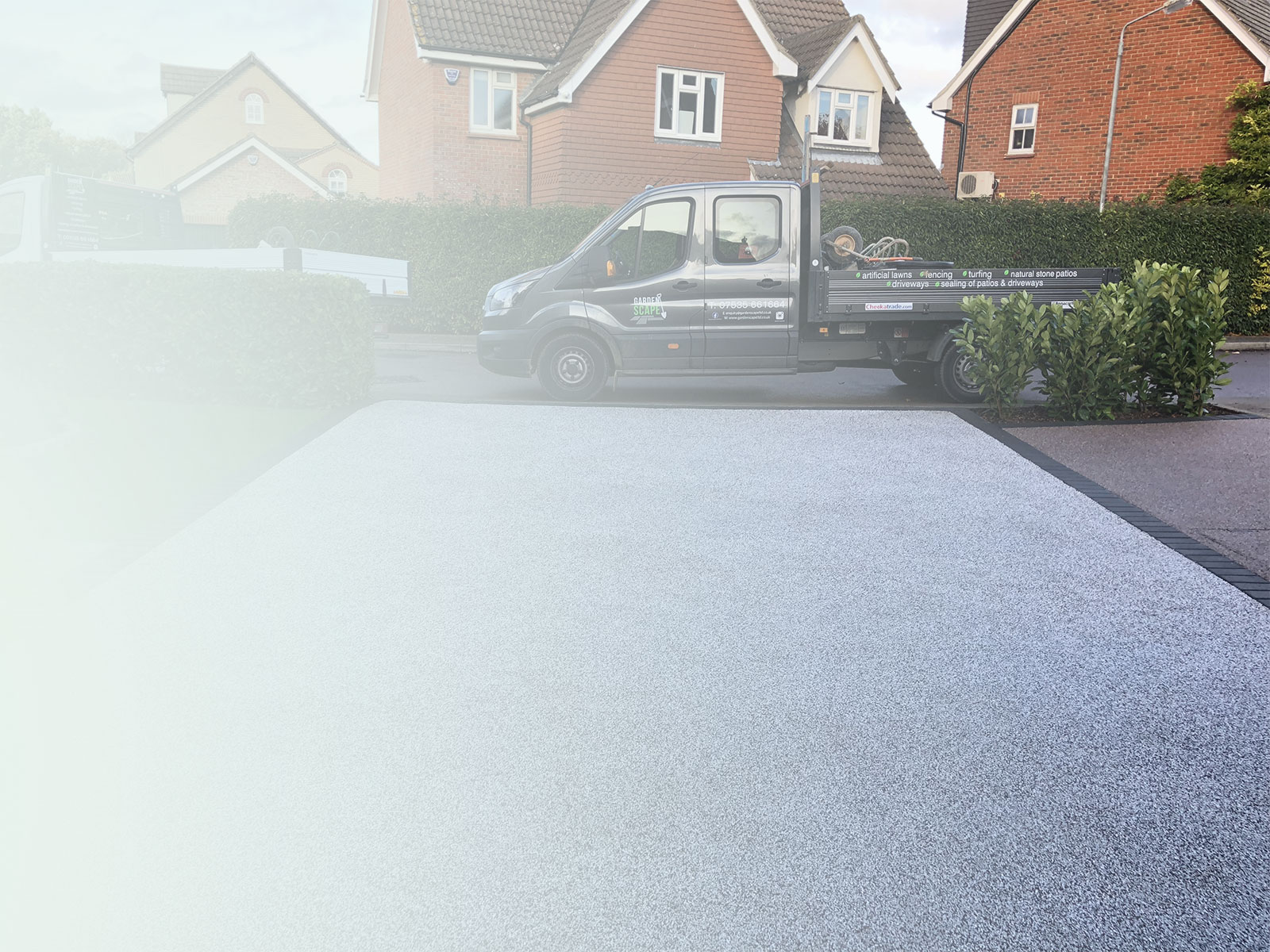
These are the drives that suit a resin-bound overlay — the existing slab becomes the base.
Cracks that mean the slab has failed
Cracks wider than a few millimetres, sections at different heights, rocking slabs or cracking that follows a wheel track all point to base failure or inadequate slab thickness. Overlaying that only transfers the problem upward.
Here the honest recommendation is to break out and rebuild, either as a new permeable surface or block paving on a proper compacted base.
Block Paving
- Hard-wearing surfaces for driveways, paths and patios
- A choice of colours and laying patterns
- Installed with the correct foundations
What an overlay involves
We check the slab, treat and bridge any static cracks, install edge restraints and drainage detailing, then lay resin-bound aggregate over the top. The result is a seamless, permeable surface without the cost and disruption of breaking out concrete.
Because concrete is impermeable, drainage has to be designed in rather than assumed.
When a local repair is sensible
A local repair is most useful when the cause is limited and the surrounding slab is stable. The loose material must be removed, the repair edges prepared and the chosen filler or repair mortar suited to the depth. Filling an active crack without addressing movement underneath is only cosmetic.
Appearance is another practical consideration. Fresh repair material rarely disappears into weathered concrete, so a structurally sound repair may remain visible. If a consistent finish matters, an overlay can be considered only after the slab has passed the stability and drainage checks.
What we check before recommending replacement
We look for movement between sections, hollow or rocking areas, repeated cracking along wheel paths and water collecting beside the drive. Those signs help separate a surface defect from a base problem.
Where the failure is widespread, breaking out the slab gives access to the cause and allows the levels, support and drainage to be rebuilt. Where it is isolated, keeping sound concrete avoids unnecessary removal. The recommendation should follow the condition of the drive, not a preference for the largest job.
Want a professional to handle it?
Related services
Covering Essex
Frequently asked questions
Can you resin over a cracked drive?
Over stable, non-structural cracking, yes. Over moving or failed slabs, no — the crack will telegraph through.
How do I test if a slab is moving?
Mark the crack ends and check them over a few months, and watch for rocking or height differences after heavy rain or frost.
Is removing concrete expensive?
It adds breaking out and disposal to the job, which is exactly why an overlay is worth assessing first.
Will filling a crack stop it returning?
Only when the crack is stable and the underlying cause is no longer moving. A filler cannot correct a weak or moving base.
Does a repaired concrete drive have to look patchy?
A local repair can remain visible against older concrete. A more even finish may need a suitable overlay, but only where the existing slab is sound.
Related reading
Not sure if your concrete can be saved?
We'll inspect the slab and give you a straight answer before quoting.