'/%3e%3cpath%20id='spade'%20class='cls-2'%20d='M196.08,56.6l13.014,57.987-0.309-9.652,5.264-1.239c1.872,8.514,1.127,16.417-3.508,21.2-6.22-2.229-10.283-9-12.255-17.49l6.371-1.5L193.731,57.155a7.077,7.077,0,0,1-7.267-5.564,7.263,7.263,0,0,1,.171-3.822l11.8-2.777A7.261,7.261,0,0,1,196.08,56.6Zm1.688-8.932-9.39,2.209a4.523,4.523,0,0,0,.1,1.237,4.82,4.82,0,0,0,5.909,3.472,4.922,4.922,0,0,0,3.822-5.762A4.461,4.461,0,0,0,197.768,47.67Z'%20transform='translate(-94.969%20-45)'/%3e%3cpath%20id='GARDEN'%20class='cls-2'%20d='M118.015,68.918H119.6V73c0,1.581-.7,2.15-1.81,2.15s-1.809-.569-1.809-2.15V61.045c0-1.581.7-2.182,1.809-2.182s1.81,0.6,1.81,2.182v2.371h3.3v-2.15c0-3.541-1.778-5.565-5.206-5.565s-5.206,2.024-5.206,5.565V72.775c0,3.541,1.778,5.565,5.206,5.565s5.206-2.024,5.206-5.565V65.756h-4.889v3.162Zm16.127-12.963h-5.111l-3.556,22.133h3.206l0.6-4.016h4.285l0.6,4.016H137.7Zm-2.731,3.92,1.683,11.193h-3.365Zm20.031,18.212a6.5,6.5,0,0,1-.381-2.688V71.985c0-2.308-.572-3.984-2.317-4.711,1.555-.727,2.285-2.213,2.285-4.49V61.045c0-3.415-1.555-5.09-5.174-5.09h-5.27V78.087h3.492V69.076h1.206c1.588,0,2.286.759,2.286,2.814v3.478a6.8,6.8,0,0,0,.317,2.719h3.556ZM145.76,59.116c1.238,0,1.777.7,1.777,2.276v2.182c0,1.771-.793,2.34-2.095,2.34h-1.365v-6.8h1.683Zm8.855,18.971h5.524c3.492,0,5.206-1.929,5.206-5.47V61.424c0-3.541-1.714-5.47-5.206-5.47h-5.524V78.087Zm5.461-18.971c1.111,0,1.777.569,1.777,2.15V72.775c0,1.581-.666,2.15-1.777,2.15h-1.969V59.116h1.969Zm12.252,0h6.032V55.954h-9.524V78.087h9.524V74.925h-6.032V68.444h4.794V65.282h-4.794V59.116Zm16.92,18.971h3.587V55.954h-3.111V69.2l-3.588-13.248h-4.38V78.087H184.9V62.057Z'%20transform='translate(-94.969%20-45)'/%3e%3cpath%20id='SCAPE'%20class='cls-3'%20d='M110.82,88.258c0,8.278,8.935,9.4,8.935,15.357,0,2.069-.915,2.814-2.369,2.814s-2.369-.745-2.369-2.814v-2.07H110.7v1.78c0,4.636,2.327,7.285,6.816,7.285s6.815-2.649,6.815-7.285c0-8.278-8.935-9.4-8.935-15.356,0-2.07.831-2.856,2.286-2.856s2.286,0.786,2.286,2.856v1.2h4.322V88.258c0-4.636-2.286-7.285-6.733-7.285S110.82,83.622,110.82,88.258Zm26.72,11.217v4.14c0,2.069-.914,2.814-2.369,2.814s-2.369-.745-2.369-2.814V87.969c0-2.07.915-2.856,2.369-2.856s2.369,0.786,2.369,2.856v3.1h4.322V88.258c0-4.636-2.327-7.285-6.815-7.285s-6.816,2.649-6.816,7.285v15.067c0,4.636,2.327,7.285,6.816,7.285s6.815-2.649,6.815-7.285v-3.85H137.54ZM156.447,81.3h-6.691L145.1,110.279h4.2l0.79-5.257h5.61l0.79,5.257H161.1Zm-3.574,5.133,2.2,14.653h-4.405ZM171.614,81.3h-6.732v28.975h4.571V99.393h2.161c4.572,0,6.816-2.525,6.816-7.161V88.465C178.43,83.829,176.186,81.3,171.614,81.3Zm0,4.139c1.455,0,2.245.662,2.245,2.732v4.346c0,2.07-.79,2.732-2.245,2.732h-2.161v-9.81h2.161Zm15.168,0h7.9V81.3H182.211v28.975h12.467V106.14h-7.9V97.654h6.275V93.515h-6.275V85.443Z'%20transform='translate(-94.969%20-45)'/%3e%3c/svg%3e)
Working out if decking has been laid the wrong way up
Deck Boards Upside Down? Which Way the Grooves Should Face
With grooved timber boards there is no single right side for every board. The grooves can face up for looks or down for a smooth finish. What matters is that water can run off, and that the boards are fixed with the right gap and fall. With composite boards it does matter: they are made with a finished face and a reverse, and fitting them the wrong way up affects the look, the grip and often the warranty.
If your deck is holding water in its grooves, turning green or starting to rot, the way the boards face is only one part of the story. Here is how to tell what is going on and what to do.
Need this sorted?
Need composite decking and fencing? Get a quote from Gardenscape.
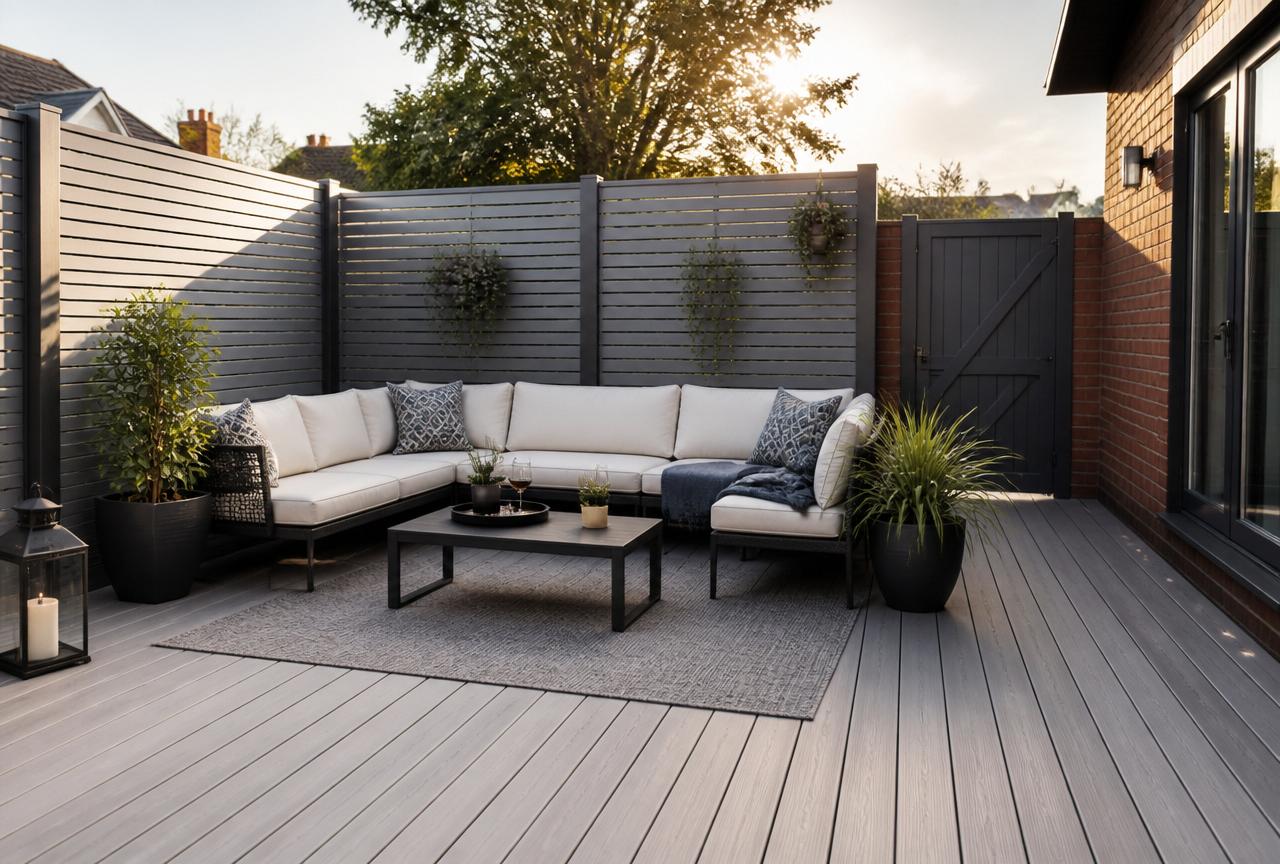
Grooved timber: up or down?
Grooves on softwood decking were traditionally marketed as anti slip, though a wet, algae covered groove is not much grippier than a smooth board. Grooves facing up give the familiar ribbed look. Grooves facing down give a smooth surface that is easier to sweep and sheds water more readily.
The problem with grooves facing up is water. Laid dead level, and running across the fall, grooves hold rain and leaves, stay damp for longer and grow algae. Over years that dampness speeds up rot, especially at board ends and fixings.
Composite boards have a definite right way up
Composite decking boards are made with a designed top face, often with a wood grain or brushed texture, and a reverse that may be grooved or hollow to save weight. The top face is what gives the intended grip and appearance, and it is the face the manufacturer's warranty assumes is facing up.
Hollow composite boards must also be fitted with the hollows facing the right way and the ends capped or finished as specified. If you are unsure, the manufacturer's fitting guide is the reference.
Composite Decking and Fencing
- Timber appearance without the upkeep
- Splinter-free, fade-resistant decking
- Composite decking and fencing supplied and installed
The real causes of a wet, rotting deck
No fall: boards should run with a slight fall away from the house so water drains along them rather than sitting.
No gaps: boards laid tight together trap water and debris between them. A consistent gap lets water through and air circulate.
Poor ventilation underneath: a frame sitting on soil with no airflow stays damp from below.
Untreated cut ends and ground contact: timber rots fastest where it is cut, fixed or touching soil.
How to fix it
If boards are sound but facing the wrong way, they can usually be lifted and turned or refixed, with the gap and fall corrected at the same time. Where boards have softened, split or rotted, they need replacing, and the frame beneath should be checked because rot in the joists is more serious than rot in the boards.
Many customers use the moment to replace softwood with composite decking, which does not rot or splinter and needs little more than a wash. Our page on rotting decking covers repair versus replacement in more depth.
Getting it right first time
We build composite decks with a proper frame, ventilation, the correct board gap and fall, and boards fitted to the manufacturer's guidance. Our ten year guarantee applies to all our work.
Want a professional to handle it?
Related services
Covering Essex
Frequently asked questions
Should deck board grooves face up or down?
On timber either can work. Grooves down gives a smoother surface that sheds water more easily. Grooves up is the traditional look but holds water if there is no fall.
Does it matter which way up composite decking goes?
Yes. Composite boards have a designed top face and a reverse. Fitting them upside down changes the look and grip and can affect the manufacturer's warranty.
Why is water sitting in my decking grooves?
Usually because the boards have no fall, run across the slope, or have been laid without gaps. The direction of the grooves makes it worse but is rarely the only cause.
Can upside down deck boards be turned over?
If the boards are sound, they can often be lifted and refixed the right way, with the gap and fall corrected at the same time.
Is rot in the boards or the frame worse?
The frame. Boards are easy to replace, but rotten joists mean the structure underneath needs repairing or rebuilding.
Related reading
Deck holding water or going soft?
We will check the boards and the frame and tell you what it really needs.