'/%3e%3cpath%20id='spade'%20class='cls-2'%20d='M196.08,56.6l13.014,57.987-0.309-9.652,5.264-1.239c1.872,8.514,1.127,16.417-3.508,21.2-6.22-2.229-10.283-9-12.255-17.49l6.371-1.5L193.731,57.155a7.077,7.077,0,0,1-7.267-5.564,7.263,7.263,0,0,1,.171-3.822l11.8-2.777A7.261,7.261,0,0,1,196.08,56.6Zm1.688-8.932-9.39,2.209a4.523,4.523,0,0,0,.1,1.237,4.82,4.82,0,0,0,5.909,3.472,4.922,4.922,0,0,0,3.822-5.762A4.461,4.461,0,0,0,197.768,47.67Z'%20transform='translate(-94.969%20-45)'/%3e%3cpath%20id='GARDEN'%20class='cls-2'%20d='M118.015,68.918H119.6V73c0,1.581-.7,2.15-1.81,2.15s-1.809-.569-1.809-2.15V61.045c0-1.581.7-2.182,1.809-2.182s1.81,0.6,1.81,2.182v2.371h3.3v-2.15c0-3.541-1.778-5.565-5.206-5.565s-5.206,2.024-5.206,5.565V72.775c0,3.541,1.778,5.565,5.206,5.565s5.206-2.024,5.206-5.565V65.756h-4.889v3.162Zm16.127-12.963h-5.111l-3.556,22.133h3.206l0.6-4.016h4.285l0.6,4.016H137.7Zm-2.731,3.92,1.683,11.193h-3.365Zm20.031,18.212a6.5,6.5,0,0,1-.381-2.688V71.985c0-2.308-.572-3.984-2.317-4.711,1.555-.727,2.285-2.213,2.285-4.49V61.045c0-3.415-1.555-5.09-5.174-5.09h-5.27V78.087h3.492V69.076h1.206c1.588,0,2.286.759,2.286,2.814v3.478a6.8,6.8,0,0,0,.317,2.719h3.556ZM145.76,59.116c1.238,0,1.777.7,1.777,2.276v2.182c0,1.771-.793,2.34-2.095,2.34h-1.365v-6.8h1.683Zm8.855,18.971h5.524c3.492,0,5.206-1.929,5.206-5.47V61.424c0-3.541-1.714-5.47-5.206-5.47h-5.524V78.087Zm5.461-18.971c1.111,0,1.777.569,1.777,2.15V72.775c0,1.581-.666,2.15-1.777,2.15h-1.969V59.116h1.969Zm12.252,0h6.032V55.954h-9.524V78.087h9.524V74.925h-6.032V68.444h4.794V65.282h-4.794V59.116Zm16.92,18.971h3.587V55.954h-3.111V69.2l-3.588-13.248h-4.38V78.087H184.9V62.057Z'%20transform='translate(-94.969%20-45)'/%3e%3cpath%20id='SCAPE'%20class='cls-3'%20d='M110.82,88.258c0,8.278,8.935,9.4,8.935,15.357,0,2.069-.915,2.814-2.369,2.814s-2.369-.745-2.369-2.814v-2.07H110.7v1.78c0,4.636,2.327,7.285,6.816,7.285s6.815-2.649,6.815-7.285c0-8.278-8.935-9.4-8.935-15.356,0-2.07.831-2.856,2.286-2.856s2.286,0.786,2.286,2.856v1.2h4.322V88.258c0-4.636-2.286-7.285-6.733-7.285S110.82,83.622,110.82,88.258Zm26.72,11.217v4.14c0,2.069-.914,2.814-2.369,2.814s-2.369-.745-2.369-2.814V87.969c0-2.07.915-2.856,2.369-2.856s2.369,0.786,2.369,2.856v3.1h4.322V88.258c0-4.636-2.327-7.285-6.815-7.285s-6.816,2.649-6.816,7.285v15.067c0,4.636,2.327,7.285,6.816,7.285s6.815-2.649,6.815-7.285v-3.85H137.54ZM156.447,81.3h-6.691L145.1,110.279h4.2l0.79-5.257h5.61l0.79,5.257H161.1Zm-3.574,5.133,2.2,14.653h-4.405ZM171.614,81.3h-6.732v28.975h4.571V99.393h2.161c4.572,0,6.816-2.525,6.816-7.161V88.465C178.43,83.829,176.186,81.3,171.614,81.3Zm0,4.139c1.455,0,2.245.662,2.245,2.732v4.346c0,2.07-.79,2.732-2.245,2.732h-2.161v-9.81h2.161Zm15.168,0h7.9V81.3H182.211v28.975h12.467V106.14h-7.9V97.654h6.275V93.515h-6.275V85.443Z'%20transform='translate(-94.969%20-45)'/%3e%3c/svg%3e)
Fire pit areas built for your garden
Gardenscape builds fire pit areas across its Essex service area, from a paved seating corner with a fire bowl to a sunken fire pit set into the garden. The fire feature is the focal point, but the surface beneath it, the seating around it and the route to it decide how well the space works.
We discuss the space on a free site visit and provide one fixed written quote for the agreed work. Tell us how you want to use the area, how many people it should seat and what is there now. This page covers the built setting; the fire feature itself is chosen with you during the survey.
Start with the surface
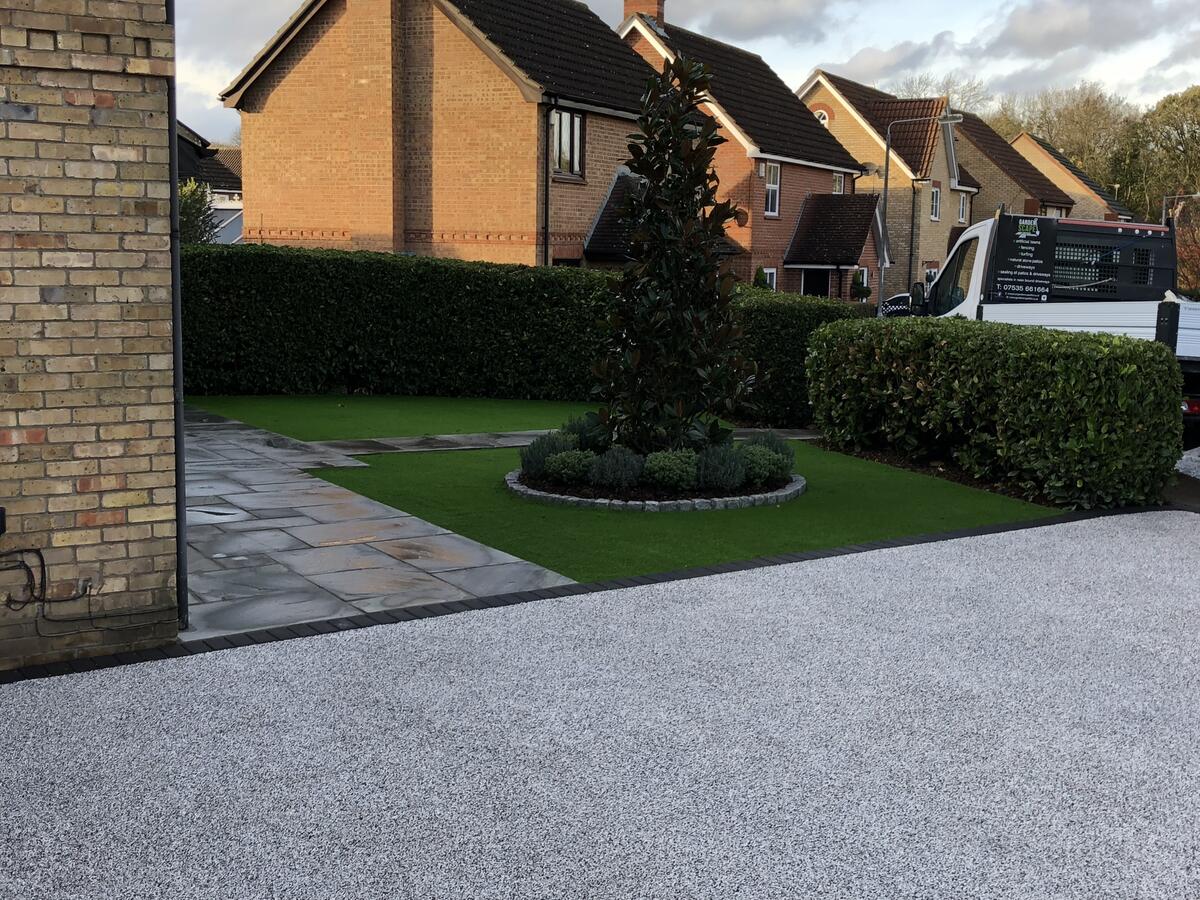
A fire pit area needs a non-combustible surface beneath and around the fire. Paving is the natural choice: a stone or porcelain patio gives a stable, level base that will not scorch the way decking or lawn can. The size of the paved area should follow the seating plan, not the other way round.
Think about how the area connects to the rest of the garden. A paved circle or square can sit within a larger patio, or stand alone as a destination at the end of a path. The route to it should be practical after dark, with firm footing and, if wanted, lighting planned at the same time.
Sunken fire pits and level changes
A sunken fire pit sets the fire below the surrounding level, often with built-in seating around the rim. It makes a sheltered, intimate space, but it is a bigger piece of construction: excavation, retaining edges, drainage and steps all need designing together. Water must not collect in the pit, so the base and any drainage are part of the specification.
A raised or surface-level fire feature is simpler and suits a smaller garden or a corner of an existing patio. Either way, the surrounding surface, the seating and the clear space around the fire are agreed before work starts. Tell us which style you have in mind and we will discuss what the garden can support.
Seating, shelter and the wider layout
Built-in seating, such as a low wall around the pit, keeps the space tidy and means furniture does not need storing. Freestanding furniture gives more flexibility. Either way, allow room to move around the fire safely and to pull a seat back without leaving the paved area.
A fire pit area often works alongside other changes: a new patio, a path, lighting or a pergola for shelter. If the project includes several elements, they are planned as one layout so levels, edges and routes meet properly. Our patios and landscape-structures pages cover those adjoining services.
Practical points and the fitted quote
Position the fire away from fences, overhanging branches and anything that could catch, and think about where smoke will drift in the usual wind. A considerate position matters for neighbours as much as for your own comfort. These are design points for the survey, not afterthoughts.
A fitted price depends on the size, the paving, any excavation or seating, access and preparation. There is no invented fire pit rate on this page. Gardenscape measures the space on a free visit and sets out one fixed written quote for the agreed work.
Your questions answered
Can a fire pit sit on an existing patio?
It depends on the surface and its condition. Paving suits a fire feature; decking and lawn do not. The survey checks what is there before the design is agreed.
Is a sunken fire pit a big job?
Bigger than a surface feature. It involves excavation, retaining edges, drainage and steps, all designed together. The survey establishes what the garden can support.
Can seating be built in around the fire?
Yes. A low wall or built-in bench can form part of the design, planned with the paving so the whole area reads as one piece of work.
How much does a fire pit area cost?
The price depends on the size, paving, any excavation or seating, access and preparation. A free site visit provides the measurements for one fixed written quote.