'/%3e%3cpath%20id='spade'%20class='cls-2'%20d='M196.08,56.6l13.014,57.987-0.309-9.652,5.264-1.239c1.872,8.514,1.127,16.417-3.508,21.2-6.22-2.229-10.283-9-12.255-17.49l6.371-1.5L193.731,57.155a7.077,7.077,0,0,1-7.267-5.564,7.263,7.263,0,0,1,.171-3.822l11.8-2.777A7.261,7.261,0,0,1,196.08,56.6Zm1.688-8.932-9.39,2.209a4.523,4.523,0,0,0,.1,1.237,4.82,4.82,0,0,0,5.909,3.472,4.922,4.922,0,0,0,3.822-5.762A4.461,4.461,0,0,0,197.768,47.67Z'%20transform='translate(-94.969%20-45)'/%3e%3cpath%20id='GARDEN'%20class='cls-2'%20d='M118.015,68.918H119.6V73c0,1.581-.7,2.15-1.81,2.15s-1.809-.569-1.809-2.15V61.045c0-1.581.7-2.182,1.809-2.182s1.81,0.6,1.81,2.182v2.371h3.3v-2.15c0-3.541-1.778-5.565-5.206-5.565s-5.206,2.024-5.206,5.565V72.775c0,3.541,1.778,5.565,5.206,5.565s5.206-2.024,5.206-5.565V65.756h-4.889v3.162Zm16.127-12.963h-5.111l-3.556,22.133h3.206l0.6-4.016h4.285l0.6,4.016H137.7Zm-2.731,3.92,1.683,11.193h-3.365Zm20.031,18.212a6.5,6.5,0,0,1-.381-2.688V71.985c0-2.308-.572-3.984-2.317-4.711,1.555-.727,2.285-2.213,2.285-4.49V61.045c0-3.415-1.555-5.09-5.174-5.09h-5.27V78.087h3.492V69.076h1.206c1.588,0,2.286.759,2.286,2.814v3.478a6.8,6.8,0,0,0,.317,2.719h3.556ZM145.76,59.116c1.238,0,1.777.7,1.777,2.276v2.182c0,1.771-.793,2.34-2.095,2.34h-1.365v-6.8h1.683Zm8.855,18.971h5.524c3.492,0,5.206-1.929,5.206-5.47V61.424c0-3.541-1.714-5.47-5.206-5.47h-5.524V78.087Zm5.461-18.971c1.111,0,1.777.569,1.777,2.15V72.775c0,1.581-.666,2.15-1.777,2.15h-1.969V59.116h1.969Zm12.252,0h6.032V55.954h-9.524V78.087h9.524V74.925h-6.032V68.444h4.794V65.282h-4.794V59.116Zm16.92,18.971h3.587V55.954h-3.111V69.2l-3.588-13.248h-4.38V78.087H184.9V62.057Z'%20transform='translate(-94.969%20-45)'/%3e%3cpath%20id='SCAPE'%20class='cls-3'%20d='M110.82,88.258c0,8.278,8.935,9.4,8.935,15.357,0,2.069-.915,2.814-2.369,2.814s-2.369-.745-2.369-2.814v-2.07H110.7v1.78c0,4.636,2.327,7.285,6.816,7.285s6.815-2.649,6.815-7.285c0-8.278-8.935-9.4-8.935-15.356,0-2.07.831-2.856,2.286-2.856s2.286,0.786,2.286,2.856v1.2h4.322V88.258c0-4.636-2.286-7.285-6.733-7.285S110.82,83.622,110.82,88.258Zm26.72,11.217v4.14c0,2.069-.914,2.814-2.369,2.814s-2.369-.745-2.369-2.814V87.969c0-2.07.915-2.856,2.369-2.856s2.369,0.786,2.369,2.856v3.1h4.322V88.258c0-4.636-2.327-7.285-6.815-7.285s-6.816,2.649-6.816,7.285v15.067c0,4.636,2.327,7.285,6.816,7.285s6.815-2.649,6.815-7.285v-3.85H137.54ZM156.447,81.3h-6.691L145.1,110.279h4.2l0.79-5.257h5.61l0.79,5.257H161.1Zm-3.574,5.133,2.2,14.653h-4.405ZM171.614,81.3h-6.732v28.975h4.571V99.393h2.161c4.572,0,6.816-2.525,6.816-7.161V88.465C178.43,83.829,176.186,81.3,171.614,81.3Zm0,4.139c1.455,0,2.245.662,2.245,2.732v4.346c0,2.07-.79,2.732-2.245,2.732h-2.161v-9.81h2.161Zm15.168,0h7.9V81.3H182.211v28.975h12.467V106.14h-7.9V97.654h6.275V93.515h-6.275V85.443Z'%20transform='translate(-94.969%20-45)'/%3e%3c/svg%3e)
Real turf laying and lawn replacement
A new real lawn starts with the ground beneath it. Gardenscape offers turfing as part of its landscaping work across Essex, whether you are replacing a worn lawn or finishing a garden after construction. We consider the soil, levels and intended use before discussing the turf itself.
Re-turfing can give a garden a fresh start, but new grass cannot remove the reasons an old lawn struggled. Tell us about persistent wet patches, shade, heavy foot traffic and earlier attempts to improve the area. The aim is to agree suitable preparation and a realistic establishment plan, not simply cover the same problem with green rolls.
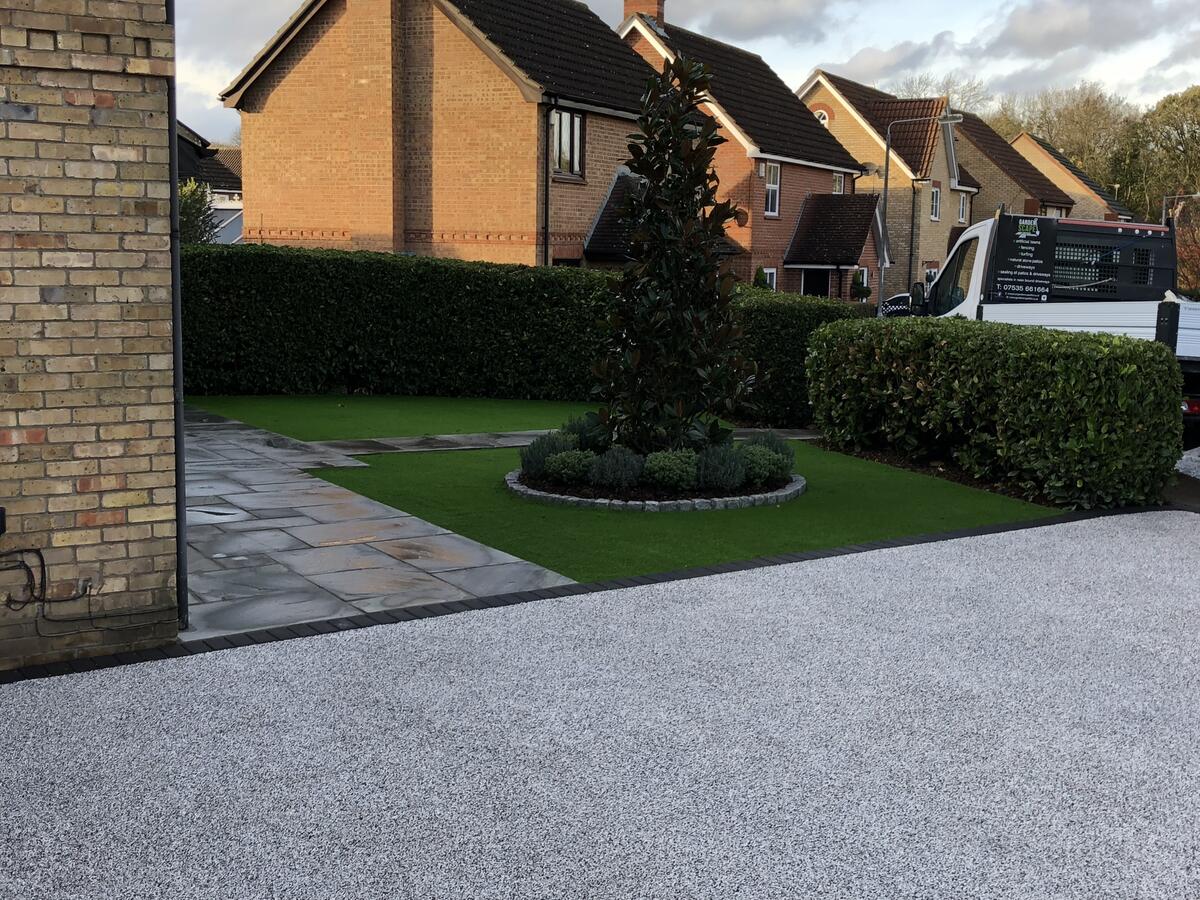
Assess the lawn you want to replace
Photographs of the whole garden and close views of bare or muddy areas help explain the brief. Note whether the damage is seasonal, concentrated around a gate or spread beneath trees. A route used daily by children, pets or wheelbarrows may need a separate path rather than another patch of grass.
Consider how much sunlight reaches the lawn and how you will mow it. Tight corners, small islands and narrow strips beside paving can be difficult to maintain. During the discussion, think about whether adjusting a border or simplifying the outline would make the replacement lawn more useful.
Prepare soil rather than burying problems
The existing lawn and unsuitable surface material need dealing with before new turf is laid. Soil preparation may include loosening compacted ground, removing weeds and stones, and adding suitable topsoil where the existing layer is inadequate. The required work depends on what is already there, not a fixed recipe for every garden.
Turf needs a prepared soil bed, unlike artificial grass installed on a constructed stone base. Buried rubble, hard layers or deep depressions can undermine the result. Discuss known building work and any former ponds or structures so the preparation allowance reflects the garden rather than just its measured area.
Set levels and drainage before laying
A lawn should meet paving and borders at usable levels without forming a low pocket that holds water. Allow for the thickness of the turf when preparing the soil. Connections to paths, edging and inspection covers need attention before the rolls arrive, while the surface can still be adjusted.
If the garden stays waterlogged, drainage assessment belongs before re-turfing. Surface compaction, poor falls and slow-draining soil need different responses. A French drain or soakaway is not automatically appropriate. Where conditions cannot support the lawn you want, discuss changes to the layout or another surface instead of repeated replacement.
Plan for a living surface to establish
Turf must make good contact with the prepared soil and remain adequately watered while roots develop. Arrange access to water and someone to look after the lawn before installation. Weather and soil conditions affect how much watering is needed; a dry spell requires closer attention than cool, damp conditions.
Keep heavy use off the new lawn while it establishes, including regular pet traffic and children’s play equipment. Mowing should follow rooting and growth rather than a date chosen in advance. If the garden is being landscaped in stages, finish disruptive deliveries and construction before turfing so the new surface is not immediately damaged.
Your questions answered
Is this real turf or artificial grass?
This service concerns living grass supplied as turf and laid onto prepared soil. Artificial grass is a separate installation with different groundwork, use and maintenance requirements.
Can you re-turf only part of a lawn?
A local replacement area can be discussed, but the cause of damage and the surrounding levels matter. New turf may initially look different from established grass, particularly where varieties and growing conditions differ.
When is the best time to lay turf?
Suitable timing depends on weather, ground conditions and the ability to water afterwards. Waterlogged or frozen soil is unsuitable for preparation, while hot, dry conditions make establishment more demanding.
How soon can we use the new lawn?
Allow the turf to root before normal use. Establishment varies with season, moisture and growing conditions, so avoid relying on a universal waiting period and discuss aftercare for your installation.