'/%3e%3cpath%20id='spade'%20class='cls-2'%20d='M196.08,56.6l13.014,57.987-0.309-9.652,5.264-1.239c1.872,8.514,1.127,16.417-3.508,21.2-6.22-2.229-10.283-9-12.255-17.49l6.371-1.5L193.731,57.155a7.077,7.077,0,0,1-7.267-5.564,7.263,7.263,0,0,1,.171-3.822l11.8-2.777A7.261,7.261,0,0,1,196.08,56.6Zm1.688-8.932-9.39,2.209a4.523,4.523,0,0,0,.1,1.237,4.82,4.82,0,0,0,5.909,3.472,4.922,4.922,0,0,0,3.822-5.762A4.461,4.461,0,0,0,197.768,47.67Z'%20transform='translate(-94.969%20-45)'/%3e%3cpath%20id='GARDEN'%20class='cls-2'%20d='M118.015,68.918H119.6V73c0,1.581-.7,2.15-1.81,2.15s-1.809-.569-1.809-2.15V61.045c0-1.581.7-2.182,1.809-2.182s1.81,0.6,1.81,2.182v2.371h3.3v-2.15c0-3.541-1.778-5.565-5.206-5.565s-5.206,2.024-5.206,5.565V72.775c0,3.541,1.778,5.565,5.206,5.565s5.206-2.024,5.206-5.565V65.756h-4.889v3.162Zm16.127-12.963h-5.111l-3.556,22.133h3.206l0.6-4.016h4.285l0.6,4.016H137.7Zm-2.731,3.92,1.683,11.193h-3.365Zm20.031,18.212a6.5,6.5,0,0,1-.381-2.688V71.985c0-2.308-.572-3.984-2.317-4.711,1.555-.727,2.285-2.213,2.285-4.49V61.045c0-3.415-1.555-5.09-5.174-5.09h-5.27V78.087h3.492V69.076h1.206c1.588,0,2.286.759,2.286,2.814v3.478a6.8,6.8,0,0,0,.317,2.719h3.556ZM145.76,59.116c1.238,0,1.777.7,1.777,2.276v2.182c0,1.771-.793,2.34-2.095,2.34h-1.365v-6.8h1.683Zm8.855,18.971h5.524c3.492,0,5.206-1.929,5.206-5.47V61.424c0-3.541-1.714-5.47-5.206-5.47h-5.524V78.087Zm5.461-18.971c1.111,0,1.777.569,1.777,2.15V72.775c0,1.581-.666,2.15-1.777,2.15h-1.969V59.116h1.969Zm12.252,0h6.032V55.954h-9.524V78.087h9.524V74.925h-6.032V68.444h4.794V65.282h-4.794V59.116Zm16.92,18.971h3.587V55.954h-3.111V69.2l-3.588-13.248h-4.38V78.087H184.9V62.057Z'%20transform='translate(-94.969%20-45)'/%3e%3cpath%20id='SCAPE'%20class='cls-3'%20d='M110.82,88.258c0,8.278,8.935,9.4,8.935,15.357,0,2.069-.915,2.814-2.369,2.814s-2.369-.745-2.369-2.814v-2.07H110.7v1.78c0,4.636,2.327,7.285,6.816,7.285s6.815-2.649,6.815-7.285c0-8.278-8.935-9.4-8.935-15.356,0-2.07.831-2.856,2.286-2.856s2.286,0.786,2.286,2.856v1.2h4.322V88.258c0-4.636-2.286-7.285-6.733-7.285S110.82,83.622,110.82,88.258Zm26.72,11.217v4.14c0,2.069-.914,2.814-2.369,2.814s-2.369-.745-2.369-2.814V87.969c0-2.07.915-2.856,2.369-2.856s2.369,0.786,2.369,2.856v3.1h4.322V88.258c0-4.636-2.327-7.285-6.815-7.285s-6.816,2.649-6.816,7.285v15.067c0,4.636,2.327,7.285,6.816,7.285s6.815-2.649,6.815-7.285v-3.85H137.54ZM156.447,81.3h-6.691L145.1,110.279h4.2l0.79-5.257h5.61l0.79,5.257H161.1Zm-3.574,5.133,2.2,14.653h-4.405ZM171.614,81.3h-6.732v28.975h4.571V99.393h2.161c4.572,0,6.816-2.525,6.816-7.161V88.465C178.43,83.829,176.186,81.3,171.614,81.3Zm0,4.139c1.455,0,2.245.662,2.245,2.732v4.346c0,2.07-.79,2.732-2.245,2.732h-2.161v-9.81h2.161Zm15.168,0h7.9V81.3H182.211v28.975h12.467V106.14h-7.9V97.654h6.275V93.515h-6.275V85.443Z'%20transform='translate(-94.969%20-45)'/%3e%3c/svg%3e)
Deciding on a long-life fencing material
Composite Fencing vs Timber: Which Is Better?
Composite fencing vs timber comes down to this: composite costs more upfront and never needs staining, while timber is cheaper to buy but needs regular treatment and earlier replacement.
Composite fencing follows the same logic as composite decking: pay more once, stop paying in maintenance. Whether that maths works depends on how long you plan to stay and how exposed the boundary is.
There are also practical differences in how the two are installed.
Maintenance and appearance
Timber needs treating to stay looking good, and untreated fences silver and eventually rot. Colour is easy to change with stain.
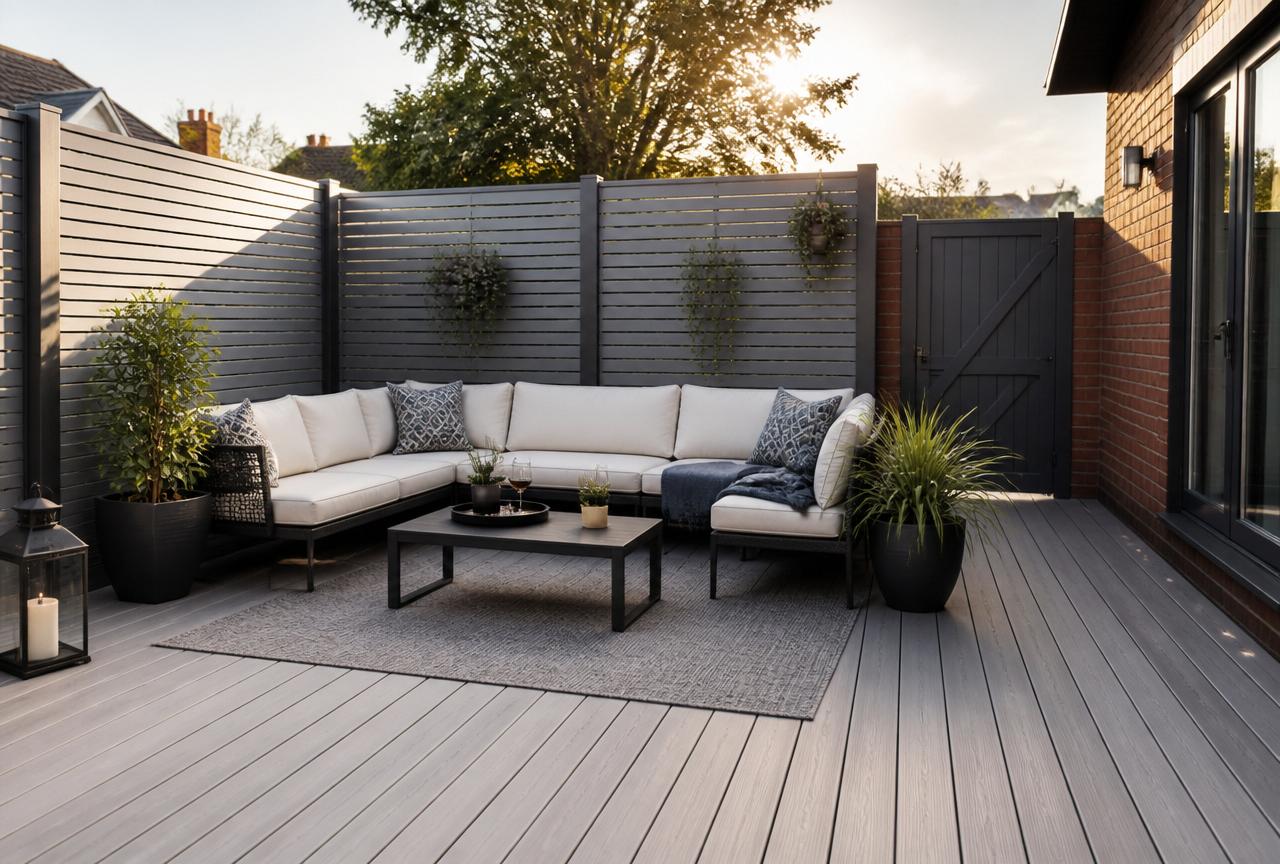
Composite is washed rather than treated and holds a consistent colour, though the palette is limited to what the manufacturer offers.
Structure and wind
Composite systems use aluminium-reinforced or slotted posts and interlocking boards, forming a rigid, solid barrier. That is strong, but it is also a solid sail — post foundations must be sized properly, particularly in exposed coastal gardens.
Timber closeboard can be built with gaps to let wind through.
Cost and repairs
Composite typically costs meaningfully more per metre installed. Individual boards slide out for replacement, which is neat, but colour-matching an older run can be an issue if the range changes.
Timber components are cheap and universally available.
Which material suits which boundary
Composite is the clearer fit when low maintenance and a consistent finish matter more than the lowest initial quote. It can also work well where the fence is prominent from the house and the chosen system suits the posts and gate details.
Timber remains the practical choice where budget, easy alterations or traditional appearance lead the decision. Closeboard can be adjusted around changes in level, individual components are widely available, and the finish can be changed later with treatment or stain.
For an exposed boundary, material alone does not answer the question. Panel height, gaps, post specification and footing depth all affect wind loading. A solid composite run needs a system designed for that exposure rather than being treated as a direct swap for lightweight timber panels.
Questions to settle before ordering
Decide whether future colour changes matter, how much routine treatment you are prepared to do and whether damaged boards must be easy to source. Check that gates, corners and stepped ground are covered by the same system rather than improvised from unmatched parts.
We measure the boundary and discuss those choices before quoting. That keeps the comparison tied to the actual garden instead of reducing it to the purchase price of a panel.
Frequently asked questions
Does composite fencing fade?
There is initial weathering; quality systems then hold colour well.
Can composite boards go into concrete posts?
Only with the manufacturer's compatible post system — mixing systems is where installations fail.
How long does composite fencing last?
Leading systems carry long warranties, typically far exceeding treated softwood.
Which is easier to repair after damage?
Timber parts are widely available and straightforward to replace. Composite boards can slide out on compatible systems, but matching an older colour or discontinued range may be harder.
Is composite always better in exposed gardens?
No. A solid composite fence catches wind, so the post system and foundations must suit the exposure. A timber design with gaps can reduce wind loading.
Related reading
Want a fence you never treat?
We install composite fencing systems with matching gates.